Showing posts with label Games and Gameplay Innovation. Show all posts

Thursday, 17 November 2011

Wargaming Aesthetics: Or Why Companies Think Gamers Buy Books By Scanning The Covers

There are a number of phrases in the English language that run the full gamut of one's life, whereas there are others that you will hear and you'll never find a use for again. A phrase that should stick with you is the adage: "Never Judge A Book By Its Cover". It is invariably true and of considerable wisdom, yet it seems in the modern world as if we never bother heeding it.

Ironically the nature of the phrase has changed. In the old days it was about not being put off by a crummy, boring cover with no special design. A book that was of artistic worth was not one that could necessarily fork out for a grand and fancy cover. But these days the methods to make one are very accessible. Go into your nearest bookstore, and look to the bestselling paperbacks. You can tell the genre just by the design on the book. Lesser known writers who write for a popular genre (in order to cash in) will often use similar designs on their books, so "Dark Fantasy" will look not entirely unlike Twilight; A Historical Mystery novel will look disturbingly similar to the cover of the De Vinci Code, etc.

The aesthetic is something modern society finds very easy to produce. It's cheap, anyone with Photoshop and 4 hours spare time can do it, and you don't actually require an awful lot of talent to produce it. Obviously, when people are preparing to buy things, they are likely to look at it for a matter of seconds, or perhaps minutes, before handing money over. So the moral of the story there is to make sure they like what they see, or at least like what they see for the amount of time it takes for them to hand their money over; even if they don't actually understand why it looks that way...


This leads me aimlessly to Games Workshop. I'm not going to deny that without Games Workshop, we probably still wouldn't have a wargaming industry, let alone one that looks so impressive, but it seems the biggest wargaming company in the history of the universe is now so big and arrogant that the aesthetic is the only thing they actually bother to get right.

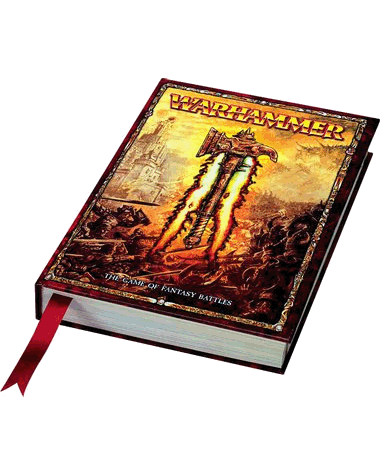
The above picture shows this particular effort rather well, and we've already discussed it previously, alongside "Finecast", and GW's propensity for Gimmicks, which also appeal to that aesthetic. Even the writing is about maintaining a very simple (but quite rubbish) aesthetic. What it spawns from is something very simple. GW want to get as much money out of you as possible, for the bare minimum effort required, but costed at a premium price that suggests the opposite. Essentially they want you to think they are artisans, when really they're something significantly less than that.

Hard-backing army books is completely unnecessary. Its singular purpose is to increase the "value" that they attach to their own produce. In other words, they want it to be more expensive. Will it last longer? It might do, but it only has to last 5 years at most, and if you manage to mangle a paperback in that amount of time, you'll mangle a hard-back just as quickly.

Marketing resin as a quality product, rather than a cheap alternative to metal is similarly an effort of saving money on their part. An awful lot, as it turns out. Made doubly worse by the fact that they're trying to save said money on a new material, based on the possibility that the previous material might get more expensive. Not only are they saving money, they decided to fool the gaming community into concluding it offers better detail and thus can charge you even more for a material that is incredibly brittle and fragile.

There's then to consider that GW hire the likes of Matthew Ward to do their writing. The guy who writes like how a staffer is trained to sell you things. It certainly isn't artistic, or even good. But it doesn't need to be. It is GW's aesthetic for 40k which is best summed up by the phrase "OMG OMG! ZOMG THIS IS AWESOMES! HOW CAN YOU NOT LIKE THE AWESOMES! ITS AWESOMES!"

The point is that ultimately it is easier for GW (and more profitable) for them to sell you something that is fundamentally flawed, but appealing enough that you are willing to put up with it, than it is to try and make a very high quality product. I might be inclined to say "good luck to them" if they did anything other than charge a premium price for a mediocre service, but that is precisely what they do.

Still, there must be something about the aesthetic, right? Something about it surely matters? Well of course it does. It's actually more important than the gaming companies even realise. It is also a bit more temperamental than they realise. Some gimmicks actually fail, not because they are ugly, but because they try to oversell the aesthetic.

I've already discussed how Rackham did this previously, with Confrontation: Age of Ragnarok, that took completely aesthetic changes that alienated its customers. Charging people more for something they will do anyway (i.e. assemble and paint their miniatures) is a particularly bad move, and the move was so bad that Rackham, a company with some promise, ultimately folded.

Still, before they did, Rackham made some of the most beautiful miniatures in the entire industry. My Top 16 Wargaming Miniatures sports 3 examples from one system. I think I can say without fear of contradiction that the majority of gamers are in it for the pretty miniatures. I'm not going to call them toy soldiers. They fundamentally are, in the same way that the Mona Lisa is a college art project.

Aesthetics are wonderful things. They are the visuals that attract. But a hobby needs to be far more than that, because it encompasses the talent and hard work of the people who support it, so you need to keep up with those people. No matter how big you think your company is, you ignore them at your peril. Because they're going to make your job more rewarding, but considerably harder:

Every release you work on, they will expand in the time that you work on other things. Every story you write, they will fold out into a saga. Every miniature you make, they will make it look better. Every rule you write, will be analysed, re-written and stream-lined. Every faction you create, they will develop them a hundred-fold. If you think they need your help to remotely be creative, you might find you've blinked and found yourself out of your depth.

Monday, 15 August 2011

Games and Gameplay Innovation: Part 4: To Refine or Expand

Introduction

It must be one of the biggest clichés in the Wargaming world, but change occurs on a regular, sometimes constant basis through two particular mediums. The first, which of the two is the least frequent, is refining; the taking of something which exists and tweaking of it to suit whatever needs are required of it. The second, which is far and away the most frequent, is expansion; the adding of new material to an existing work. Both of these are things we all see in many Wargames, and it is most likely the two things we keep the most track of.

There are many reasons for this, but ultimately in the gaming world, not taking notice of such change tends to have negative consequences. It is also hard to miss when a rules system changes, or a new shiny faction comes out, or is reinvented. It affects the entire gaming community, especially if you play GW games.

The contrast between the two is worth noting, as they both have a massive impact on the games we play, and most games vary as to which of the two they do best, if either of them at all. Through the course of this particular post, I'd like to discuss some of what I feel are the successes and failures of games with regards to refining and expanding.

Expansion

It is probably wise to start with expansion, as of the two it is virtually a constant. The way most games are means that you are more likely to see something new than see something existing being fiddled with. Usually, as has been discussed before, new things are often introduced as a sweetener to justify change. GW are particularly infamous for this, relying on new gimmicks to justify a rehash of a old system.

Expansion is something we are used to seeing. Privateer Press even themed whole releases and new books around the concept, with names such as "Escalation" and "Superiority", and introducing "Epic" versions of their Warcaster characters. The reason is as blatant as the naming, most companies up the ante. A lot of Wargaming is built upon tension, and if you keep that aspect building, so too should interest.

Plus, we all get bored, and we want to see our factions improve, evolve and change. Expansion is a common factor, something a wargamer expects. If you are playing a game using miniatures, you expect to see more of them. In Historical wargaming, you can have massive wars to cover, so many different regiments, types of tanks, new innovations and warmachines etc.

Besides, it isn't just miniatures that are expanded upon, but so too are rulesets. New rules come out of playing, new expanded concepts, rules to cover new issues or developments, new scenarios and battle types, new ideas, campaign rules, new unit rules, and so much more.

There was a time when the best example of this was actually Games Workshop. All of their games, WHFB, 40k, LOTR, and all the specialist games would get new rules and expanded ideas that were frequently published in magazines. Some were submitted by fans, but others were developed. This occurred to such an extent that people started actively hating White Dwarf because it no longer featured new rules, or any article that was remotely doing anything other than excusing the White Dwarf from being a catalogue that you pay for.

GW had a golden age that they no longer explore. The trouble with expansion, of course, is that it leads to imbalance within rulesets, especially if you don't develop all factions equally. Privateer Press has for a time, managed to avoid this, but trying to expand on the number of factions may bring a detriment to this.

By far the worst example of excess that I can think of is Confrontation. That was a game that swelled to the very edges with a massive excess amount of rules, which it tried to manage in an incredibly complex fashion. There was no way you could remember the 7 or so pages of abilities within the book, let alone the myriad of incredibly complex turn aspects.

Refining

Mentioning confrontation leads me to refining. A Wargaming producer's constant struggle is that of managing everything into a cohesive and balanced system (apart from GW, who just want you to know what edition it is). What keeps people playing games is the challenge, and the social interaction. The best way to facilitate both is to make sure your system runs smoothly.

Refining is what makes the difference between a good game and a great game. Some games try to bypass this with gimmicks (40k, WHFB) or polish (Confrontation, 40k, WHFB) but the mark of a really good system is the ability to make things work within a well-defined system.

Privateer Press have even being struggling with this of late, but for me, Warmachine and Hordes represents a very good example of a refined system. PP knows what works, and what their game is. Anyone who plays it can be under no illusions of what the game is about, or how it is played. I learnt more or less the entirety of how to play Warmachine the first time I played it. I am still learning about Warhammer and Warhammer 40,000 every single day that goes by.

The difference is the strength of the ruleset. Warmachine and Hordes has a very well-defined system. Other rules adhere to the existing rules. So whilst a rule or unit might be new to you, how it interacts with the system is something you are most likely familiar with. In contrast, with the likes of 40k, you don't know, because so many rules contradict, or outright re-write the core rules, so you are often faced with the question of what is intended, without being able to logically determine it. Pretty much all of GW's FAQ documents are far too short, and will never be full enough for their fans. If they had refined the system into one where all rules share a unified concept, they wouldn't have to.

Even a refined system needs explaining, but the difference is one of confidence. If your system does its job, the rules are interpreted more smoothly, and people have more time to enjoy playing a game.

To Refine or Expand

Related to this is how one decides to expand or refine. In rules terms, you need to be able to decide when to add more, simplify, or to completely redefine. You also need to know when is the right time to apply either of those three (for an example of how not to do this, compare two editions of any GW game). Rules that are clunky need either to be simplified or redefined. You certainly shouldn't expand on such a concept if the original concept doesn't really work.

You could be easily led to the question of which is more important, and the answer is that they are all equally important. You should always refine and expand. You should never be afraid to add too much to a system, merely too little. People know what they want out of a game, so additional optional rules should always be welcome; the only issue is finding an appropriate place to introduce them. GW books such as Cityfight, Planetstrike, Apocalypse and the recent Storm of Magic are all very good examples of how to appropriately add more potential options to a game. GW most likely peaked with the Specialist Games website, and Fantasy's General's Compendium.

People are always looking to try new things and add more to their experience. In that situation refining becomes increasingly difficult. But ultimately if you know what requires refining, it isn't as difficult as it seems. It is the integrity of the fundamental core system, and the balance of individual factions that requires refining. Expansion beyond that will always attract the audience that wants it, and trust me, they will make such things work.

The biggest travesty to any Wargame is to take away expanded ideas, and an even bigger travesty is to not even refine what aught to be refined. If you want the best example of this, seek out your nearest Games Workshop. You'll find 3 particularly horrific examples.

Friday, 11 February 2011

Games and Gameplay Innovation: Part 3: The Issue of Change

Photobucket

I first started gaming in 1994; the year that D:Ream had topped the UK charts with the song "Things Can only Get Better". As always with the UK, it was an optimistic symbol of hope, that ended up standing for the exact opposite. It ended its short, but increasingly festering career as the theme song for Tony Blair's New Labour election campaign; with a unique performance of the song during their election victory party. So that went well, didn't it? One day I would like to meet the members of D:Ream so I can shout at them for getting my sodding hopes up. I suppose I could clip Howard Jones around the lug at the same time.

The point is, not all change is good. Change is the reserve of the optimist. Now, those who follow this blog regularly will know a particular fact about me. I'm not an optimist.

Change to me invokes several emotions, and one of them is always deep concern. It is something I learnt in part from playing Games Workshop games (whose rules change more often than a schizophrenic leopard in an abattoir), but also because any gamer has emotional and financial concerns with any gaming system.

For the computer gamer, change is annoying, and expensive if you want to change immediately. But the expense generally encountered by a wargamer is significantly larger than this, and can be something of a constant for some gamers.

Especially with GW games, such as 40k and WHFB, where there is an edition change about every 5 years, bringing out a new rulebook (of increasingly significant expense), and at some point during the run of a new edition, every single faction will be treat to a new Army Book or Codex, throughout the run, with a significant amount of new shiny models that most likely you'll want to buy, and in many cases, usually have to.

Change is realistic for any game. You need to keep people buying if you want to further support, but each change runs the risk of undermining your fanbase, their interests, and the whole ethos of the game you wish to promote.

The main problem is, that if you are releasing a new rulebook, it needs to be noticeably different to justify the gamer's expense. If you just change the artwork in it, gamers are going to feel cheated. Every single change you make will impact on the nature of the game that your fans have been buying.

As we have seen in my previous article in this series, this often lends itself to gimmicks. If you are going to change the ruleset, you need to attract attention to some particular mechanic or aspect that you are inevitably going to deem as "ground breaking" or "innovative".

This runs a number of risks, most prominently, breaking the game away from what it originally was, and risking a fan-revolt. Rackham managed to achieve this quite spectacularly on several levels with Confrontation: Age of Ragnarok, which rebooted the old Confrontation Skirmish system into a regiment based wargame with pre-painted miniatures mounted on different bases. This forced gamers to challenge a lot of their ideas and perceptions they had about the game they loved, and it made most of them noticeably furious.

This is something that generally gets rather understated when it comes to gaming. The integrity of games is always put in question when a change looms along the horizon. Whilst most will put up and shut up, or immediately drop the game and seek other entertainment, an increasing number of gamers and hobbyists are getting increasingly insecure about their gaming environment.

This situation is so pronounced, that with GW games, generally more discussion is dedicated to speculation and debate about change (no matter how far off it is) than the existing merits of the product as it stands. It seems the gamer's coping mechanism (and can you blame them) is to have as fluid a concept of the game so that they never find themselves in such an existential crisis as some gamers who get attached to a particular way of playing end up facing.

Games Workshop's change is virtually constant, bringing out a new faction every 3 months, and with two cores where this occurs regularly, it can seem like every other month, there is something else to buy. The worst of it is that despite this constant change, the product support to keep the game more or less intact is positively non-existant.

There is no way to directly contact the writers, and despite some customer support existing to address some rules and gaming issues, only this week I encountered one email from a customer service representative of Games Workshop that simply had to be wrong. The "answer" provided was with reference to whether Zzap Guns (an Ork Big Gun) hits automatically. The Ork Codex says nothing of the sort, but a summary in the 40k rulebook says it does. The responding email to this question confirmed it did, because the rulebook said so. But it said so in a summary, clearly labelled with a disclaimer that any discrepancies in the summary are overwritten by the Codex.

It doesn't help that GW's writing is poor and inconsistent (but more on that in another article), but it is a prime example of the fact that too much change can constrict a gaming system. Warmachine has changed recently, and this has provoked a lot of controversy (as I said earlier, gamers, quite rightly, hate change). But the difference, to my eyes at least, is consistency.

If you are changing a system, you need to keep it fairly consistent. The game may need improvement, you may also want to encourage sales, but you also have to spare a thought for the gamers who already support you, because they already like what you have produced, or else they wouldn't front you any money.

You need to consider the integrity of the game, what it stands for. If you change that completely, you are going to undermine your own fanbase considerably. It is of even more importance if you have several inter-playable systems. Rackham had 4 it managed to undermine. Privateer Press has technically 3 (although Iron Kingdoms merely shares models, not a ruleset with Warmachine and Hordes). Games Workshop has a number, but the most notable is LOTR and WOTR. The important point to bear in mind that if you are going to change a system, it impacts on the others it is connected to. So, Hordes players will react to change in Warmachine (and vice versa), so had better make sure that you don't undermine the ethos or style of either game.

Change is often necessary, but it is not without risk. The other companies should take note to notice what happens when change starts occurring to a ruleset merely for the sake of it...

Photobucket

Monday, 17 January 2011

Games and Gameplay Innovation: Part 2: Gimmickhammer

Photobucket

What makes a good game?

I'm sure we all have some inclination as to the answer. A lot of it is taste. The favourable internet expression for this is your mileage may vary (or YMMV). Throughout my wargaming "career" (the one I've paid other people for), I've striven to get to grips with this subject. Not least, because I actually write my own gaming systems, and fiddle with existing ones. The concept is something I think all rules writers consciously think about, in the same vein that a writer of fiction considers narrative devices, and the film maker considers myriad cinematic approaches: camera angles, soundtracks, lighting, casting etc.

Anything produced for any medium has a sense of style and theories surrounding it. The Critic in particular looks into these, as a critic does of any other work. You generally have to form an opinion of what works and what doesn't in order to discuss it. This can run the risk of being too interpretive of something (like a film critic going on about the "innovative" and "brave" switch to black and white, or less CG in a film, when in all likelihood they simply ran out of money).

One can also be a tad too elitist, or dismissive of something that doesn't really bother other people. The trouble is, that is what the critic is for. If you endeavour to understand any medium, you inevitably find its foibles. It comes with the territory, especially when your quest is to determine the best concepts to work with, you are inevitably going to find issue with solutions people use.

This brings me quite well into the realm of Games Workshop. They have their fair share of critics, and as the "most popular" out there, they have a nice selection of examples. It also makes them an easy target, but then, I don't think a medium attracting a larger crowd makes it any less worth criticising. If anything, it probably warrants it more. If it improves, it benefits more people.

The worst thing a Wargame can do, is much the same as a computer game can do. That of offering up some kind of gimmick, whose purpose is ultimately designed merely to pull in the audience. The word "innovation" or in particular the adjective "innovative" is thrown around by fans and popularisers about various incarnations of GW's big three: Warhammer, Warhammer 40,000 and Lord of the Rings (or the pointless War of the Ring).

A good approach to the psychology of wargaming is to make a wargaming feature easy to use, and/or intuitive, so that the gamer relies more on their perception and instincts, and less of the actual rulebooks. Good system concepts can be ruined by far too much "lawyerese" language that tries to avoid exploitation. 40k in particular suffers from this tendency to reword subjects and concepts to fit new situations, rather than trying to make a system that fundamentally stays consistent (like Warmachine to some extent).

Also, just because you feel you've "involved" the player in the system directly, does not remove the need for you to make sure the system itself is well-handled, or even if it works at all for the system you are using it for. A good example of how this doesn't work, is Warhammer 40,000 5th Edition's True Line of Sight (or TLOS).

True Line of Sight is used in many systems, although only Games Workshop could be so cocky as calling it "getting down to the model's eye view to observe the battlefield, bring you directly into the games you play". It basically entails that what the miniature can see, can be targeted. Cover may be considered if the model is in any way obscured. In some games (such as Necromunda and Warmachine) you also have to observe the degree of obscurity with usually two or three (sometimes more) defined terms that have an additional affect on gameplay.

Although the original system was quite clunky and prone to causing arguments, it worked on a consistent set of definitions, and suited the style of the game. What do I mean by this? Well, terrain was judged on an estimated basis; forest terrain would be impossible to see through at a certain depth. As 40k has never really been particularly appropriately scaled, reverting to a system of seeing things as they are presented, causes a number of problems. In particular, those floating around in the air, or elevated by scenic bases become discouraged, which is one concept that Games Workshop has consistently promoted, and until 5th Edition, never affected gameplay.

In particular, Wargaming terrain is also generally designed for ease of use in games. "Forests" comprise of three or four trees, often ones that can be lifted away if movement becomes a problem. Things have been estimated around ease of use, rather than to provide adequate cover. When you use TLOS with typical Games Workshop scenery, you very rarely block visibility at all, which is a poor consideration.

Even without these aesthetic issues, it isn't really a concept particularly suitable for the 40k system. Cover provides "cover saves", which can be taken instead of a regular save, or prevent vehicles from being damaged if the save is passed. This itself is a particularly muddy subject, and has caused a number of issues, especially for countries where English is not the main language, such as a particularly unfavourable ruling on the effects of a Kustom Force Field upon vehicles in Poland.

Now, as 40k goes, the easiest tactic is to roll lots of dice, and make your opponent roll lots of dice. It is actually possible to come close to breaking the game quite easily by simply being able to see lots of units with long or medium range firepower and spamming them ad infinitum. Your opponent will get cover saves for those that go through cover, even other units (but as we've seen, it is very difficult to outright block visibility), but you can let them have that, knowing that often, any dice rolled on the lower scales (1 and 2 in particular, sometimes 3) are going to result in casualties, whether AP or any other issue comes into it or not.

Sure there is the Go To Ground rule that sacrifices the unit's turn in order to improve the cover save, but no matter how good a concept this is to slightly improve the TLOS system, you still have the same likelihood of casualties. Weapons that normally ignore armour will suffer, but weights of fire will not.

This is the problem with TLOS in 40k, because it places the main drawback of firing through difficult circumstances upon your opponent, when it should be the other way around. Given the propensity for 40k players to have some version of Power Armoured Space Marines (who really need very little aid to survivability anyway), most often this facility will simply not get used. When it does, it will provide a very minor defence against an attack that should have been greatly reduced in effectiveness, but works essentially, more or less the same as it would in the open.

It benefits those with poor armour saves, but those forces are typically fast, or have means of distracting enemy fire. Plus, one really wonders if the original system would not have worked just as well, if not better, by simply integrating the units providing cover to other units concept into the existing system in 3rd/4th Edition. It would have been easy, as the rule already existed for Gretchin in the 3rd Edition Ork Codex.

Places where TLOS have worked well is the likes of smaller scale skirmishes, such as Necromunda, Hordes and Warmachine, where cover has impacted on the accuracy and likelihood (or lack thereof) of hitting, rather than the propensity for a seldom-used defensive gimmick. Funnily older versions of 40k used this system, and Warhammer Fantasy (no less capable of large scale battles) still uses it.

This whole concept does play to the idea that certain Wargames market themselves to particular consumers, or particular groups of intellect (or both). Privateer Press' Warmachine and Hordes market themselves to power gamers, pushing forth the gimmick of playing to tear your opponent's liver out (with a small hint to the effect that this should extend merely to the gaming table, with some mention of those weird concepts called manners and sportsmanship); LOTR in particular plays to the aesthetic of the films (a sparkle doomed to diminish as the films disappeared - perhaps GW is holding out in hope of being able to represent The Hobbit too?); Warhammer very much markets the historic style of wargaming, with modern powergaming thrown in; and 40k markets itself as a fun system, with space marines.

40k itself seems to make very little assumptions about the age (or intellect) of its audience, and assumes it hates maths, English, critical thinking, or game theory. GW really don't read forums much, do they? Do they assume that players can't be bothered to subtract or do any amount of numeric considerations? They certainly squandered a wonderful and adaptable Wargear section in order to make it "easier" and "quicker" to write army lists. Funnily, you have all the time in the world to write army lists. It's playing games without needing to check the rules every two minutes and arguing about them for hours on end that I'd rather avoid.

It leads me to the conclusion, in a roundabout way. Always be wary of concepts in rules that are designed mostly around a "pull" to attract you to play. In the same way that you should be wary about those bullet points on the back of a computer game box (which more often than not are merely gimmicks that comprise of your entire gaming experience - such as a gimmicky gun that only has one particular use).

Photobucket

In much the same way, Wargames can do this to attract new interest. The trouble is, if not well-handled, this becomes yet another bugbear to deal with for anything other than the casual gamer. Unfortunately, most money is often spent by casual gamers and children (in most gaming industries) who often have little conception for the overall quality of a work. Until those interest areas start to dry up, many companies will avoid cleaning up their act. GW especially.

It can really make you feel for the dedicated fans of a system, who have to endure change. Most of these companies have more or less forgotten about you. You've spent your money, so they need fresh people. This can be particularly jarring when a game takes a radically new direction, and virtually undermines the fanbase. You're expecting a GW reference, but fear not. There has been one company to pull a bigger dick-move than anything GW has ever done. Step forward Rackham, for their reset button action of Confrontation, spawning the infinitely poor replacement Confrontation: Age of Ragnarok (which incidentally undermined 4 games, of which only two - Confrontation (but so many factions have been reset to virtually nil, and old models - that are infinitely collectible - essentially need rebasing(!) to play) and Cadwallon (which from the looks of it, is ridiculously expensive to play) have made much of a comeback. Did I mention the models aren't as nice looking?

Photobucket

Age of Ragnarok also lets us round off with one more gimmick. Pre-painted miniatures. This is a particularly large bugbear for anyone who views Wargaming as a hobby, and not just a game. For gamers, it is rather pick up and play, but for this convenience, all gamers/hobbyists are paying a massive premium for them to be pre-painted (not only the painting costs, but the elaborate packaging that is necessary so you can see them before you buy) and anyone who wants to customise or improve the appearance of those miniatures are going to put paint to them anyway, rendering the entire process redundant. Plus, At43 demonstrated already quite well that the gimmick alone does not a gaming system make. The system itself actually needs to be decent as well.

It is rather telling when all you read about on forums is discussion of how to modify the models for use in other games.

Now, not all gimmicks are bad, but always be wary of ones designed to integrate the gamer into the system. This kind of concept needs to be handled extremely well to satisfy gamers, and with a lot of gamers being insecure and temperamental, you really have to make sure that your changes stand up to scrutiny. Step up 40k. Step up Fantasy. Step up War of the Ring. Step up Warmachine Mk2. Step up Age of Ragnarok. Step up Necromunda: Underhive (an old gripe, that) and finally, step up Inquisitor, for always being a gimmick. Maybe that's why we love you. Well, why those people love you.

Wednesday, 22 December 2010

Games and Gameplay Innovation: Part 1: Introduction

I've been neglecting this blog of late; although one can't really dream of wide readership, especially when you're knocking something everyone likes.  Despite this, however, this Blog has been dedicatedly tame in comparison to some of the bile you find on forums.  It surprises me in no small part because I contribute fairly heavily to the bile you find on forums.

I think I'll put it down in a large part to my own maturity and freedom within a new media, when if you contrast forums, of which I've been a member of in some occasions for many years, which usually means my late teens.  That is soon to be 7 years ago, and frankly, I'm a little tired of still being in the same mould.  You see it is pretty easy to spout bile on forums, and when you feel the need to grow up a little bit, or "lighten up" you are doing so with the added difficulty of redefining your "online forum membership persona" and it can be extremely difficult to step back from it, and remind yourself that you're a lot older than you were when you started it.

You see, this leads me to Games, because Games get older and change (bask in the glory of my horrendous linkage), much in the same way as you do, and your relationships with them change.  This generally leads you to being disaffected, even angry, about something you had very little input in steering, if any.  Although as most people in this world knows, you spent a lot of money on it, and other investments, so you probably feel like you are owed some shares in it.  Here's to hoping, maggots.

[How I miss that Nightmare board game.  Remember when it was you who was the little maggot?]

There are many ways to combat it, but as my last article demonstrates, most people expect you to kindly take your opinions elsewhere or put up and shut up.  When you find yourself so convinced that everyone else is wrong, it can be hard to make either commitment, especially when you still care.  In particular, Games Workshop and its myriad of employees should have got used to this by now.  Their leopard has changed its spots so often that it is now actually a Tiger.  Or a Wildebeest.  Or a stoat.  Or a halibut.  Or more likely, it's just yet another in a long line of red herrings.

Privateer Press, on the other hand, is quite new to this.  Judging from Warmachine Mk 2, they might need some practice...

Games often change, and despite any indication to the contrary, every company who makes one will always say it is for the best, it needs it, etc, rather than more obvious reason that they need to keep on making money, and thus need to re-sell you everything again.  That comes with the pretence of change, because everyone has been telling you for the past 3 years that Citizen Kane looks so much better in HD.

Now, Wargames, for their part, do actually change.  They have to really, because if you're selling another book which simply allows people to play, you had better have done something with it, even if it is simply to make it 500% thicker , increase the price and actually make it so that games are even bigger, and not particularly that much better than they were last time.

One wonders whether GW realised the practicalities of a needlessly oversized and heavy TOME for a moderately scaled tabletop wargame.  Sure, there's the little book in their boxed set, but what's the point in the other one?  Don't tell me there's some moron out there who thinks GW's rules are good enough to be collectable? 

One second: **searches the internet**

My God...

Anyway, Gameplay innovation can come hand in hand with change, as it is when it is first introduced.  Sure there is innovation from previous editions, but I would like to explore the whole concept of Games Mechanics and Innovation in the Wargaming Hobby.  In GW's case, it probably wont take me very long, so I thought initially it might be a good idea if the next part of this series discussed Gimmicks.

Until then,

TWC