Showing posts with label The Wargaming Cynic Series. Show all posts

Monday, 7 November 2011

Chaos: Or why you shouldn't bother converting

Sigh. I keep neglecting this blog. But not to worry, I'm going to keep going. So I thought it would be nice to start with a controversial one, whilst I'm still in a suitably irritated mood.


The more I think about it, the more I'm convinced that Chaos players are living in a dream world. Not that this is a bad thing, considering that if you didn't, you'd be like me, an Ex-Chaos player. Because if you work hard enough, you can convince not only yourself, but also other people that Chaos are a really cool faction in 40k.

This is what gets me, because if you read the current Codex, you'd be forgiven for wondering why.

It isn't just as the demotivator above says; the Chaos Codex isn't just outdated, it was pretty terrible when it was first released. It had a few competitive things within it, such as the Lash, Daemon Princes remain fairly nasty, and some units got much needed improved stats (Plague Marines and Berzerkers to name two). But ultimately what is missing from the Chaos Codex is the whole, umm, Chaos bit.

It was particularly obvious back then, when the new Codex came out, replacing the previous one that offered tonnes of options in the way that 4th Edition Codexes did at the time. 4th Ed Chaos may well have been the best Codex of that edition; offering tonnes of options, themes and at the same time, making a lot of the myriad legions of chaos possible and attractive as an army choice.

The previous Codex had a section devoted purely to God Specific wargear, god-specific army builds (that rewarded you for being true to your favourite god) and also legion specific rules, allowing you to build the likes of Iron Warriors, Word Bearers, etc. Considering the fluff has always stated that the Chaos Gods are supposed to hate each other, one-god forces are supposed to be fairly practical, you'd think.

The wargear was considerable and varied. They were noticeably Chaotic, setting themselves aside from other factions (such as marines) to a considerable extent. It was possibly too good, because it offered such potential, in spite of having a pretty mediocre existing miniatures range, that much like the Old Orks, it really encouraged the modelling and converting that Chaos soon became famous for.

It was also around this time that pretty much every Chaos player rocked an absolutely awesome Chaos lord, with their own character and abilities. When the new Chaos Codex rolled along, Chaos players found their options drastically reduced, the loss of Daemons (anyone telling you that page of generic "Summoned Daemons" are actually Daemons are lying) and an extreme overuse of Special Characters and gimmicks throughout the codex, and space marines.

Space Marines are to be expected, sure, but the problem is that's all the current Codex actually is. This is 5th Edition after all. We have grown to expect the gimmicks, because that's what 5th is all about, the same goes for the over-prominence of Special Characters. But you have to try very, very hard to make bland Space Marines. Which was proven when every other power armoured Codex that has rolled along since has made Chaos' "Marked Units" look so utterly quaint and pointless.

Marked Units were essentially GW's way of adding "Chaos" to the Codex, aside of the Lash and Special Characters. Take away those and you pretty much have a very generic and unimaginative Space Marines Codex. But although Chaos Space Marines are Space Marines, they used to be so much more than that. For a start, you could actually tell the difference, you could manifest the fruits of that schism on the tabletop.

Putting it simply, we had the Axes of Khorne, Kai Guns, interesting Daemon Weapons, Daemonic upgrades, special powers, and actual Chaos vehicle upgrades. What do we have now? Regular Space Marine options. Power Weapons, Lightning Claws, Power Fists. For vehicles, it's Dozer Blades, Extra Armour, Smoke Launchers etc. Fine, that's cool and everything, but if I wanted just those things I could take them very easily in a loyalist Marine force. Even the 3rd Edition Dark Angels, Black Templars and Blood Angels Codexes managed to do that whilst adding in a few unique things. The current Codex offers the Lash, and the rather disappointing Daemon Weapon.


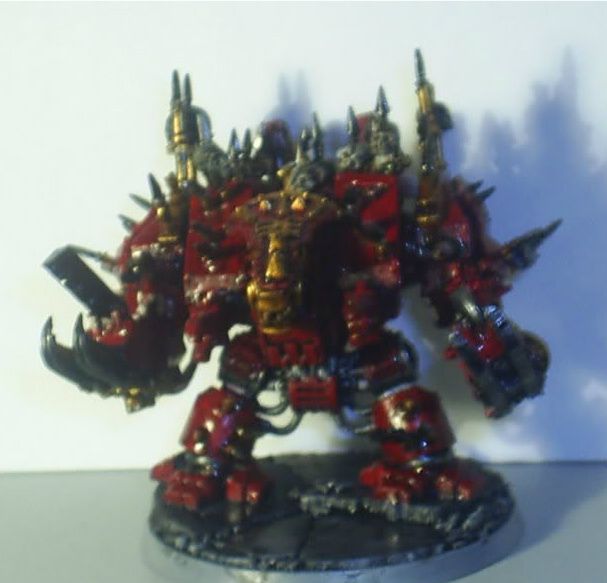
Back in 4th Ed, pretty much every other Chaos player had a Possessed Dreadnought. I had one with the Khornate vehicle upgrade (Destroyer), and it cost me an awful lot of money to make it (see the results above, cost me about £60-70 at the time). Now you can possess tanks, but not Dreadnoughts. Why? The worst of it is that Marines followed fairly swiftly after the rules change and the loyalists got 3 different types of Dreadnought, all cooler than the Chaos version.

Independent Characters also suffered. In my time as a Chaos player, I made no fewer than 10 Chaos Lord/Lieutenant models. Of those models, a pathetic two of them remained WYSIWYG (What You See Is What You Get) when the new Codex came out, due to awkward upgrade and options placement, and the removal of any sanity with regards to allotting wargear in any Codex in the whole of 5th Edition, and as 6th Edition rears its disgusting face it shows no signs of returning.

It highlighted a fundamental problem with the new options layout: it was far too dogmatic, making some fairly logical and popular weapon options completely impossible. Being forced to take a gun of some form has caused many 40k players who remember 40k before 5th Edition to pull their hair out and chuck their lavishly built and converted models against the walls of GW "Hobby Centres".

What made that pill so difficult to swallow was that there are a few Chaos Special Characters that have two close combat weapons, or at least weapons that were impossible to even get close to with the current options. There's Abaddon of course, but the worst offender is the new Red Corsairs character Huron Blackheart. His weapon options are incredibly cool, but in contrast to the regular Chaos Lord, he's offensively cool.

The options for building Chaos Lords is barely any different to that of any Space Marine Hero. This becomes even worse when you consider that he usually ends up being more expensive for a lot less advantages. Aside of marks, the only option of difference is the Daemon Weapon, which is a problematic, occasionally useful upgrade at best. The Khorne Variation is slightly more practical than the previous Berserker Glaive, but very likely to do absolutely nothing when you need it more than ever.

What the current codex made me realise is that Chaos just isn't Chaos without oodles of interesting rules and wargear. The Chaos Codex as it stands lacks both. It has a handful of gimmicks to make up for it, such restrictive options as to be offensive to anyone who takes the effort to model unique Chaos Models for their army, and highlights a fundamental problem that GW has only exacerbated in recent years.


Warhammer 40,000 is changing in tone. There was a time, when Loyalist Space Marines were depicted as usually on the receiving end of bitter defeat. Most of their endings were bittersweet, being pyrrhic victories at best. It was common to show Space Marines facing death, bravely, but facing a ultimately (and usually subtle) futile outcome. This vision has been slowly changing, most likely as an effort by GW to simplify 40k for their rather youthful target audience (despite the fact that this target audience has loved 40k as it was for at least a decade or so anyway), and give clear messages about good guys and bad guys.

The dark and depressing future is being replaced with one where Space Marines are ridiculously awesome. Grey Knights barely registering a shrug, before easily resisting the taint of chaos and rendering it asunder as if they're a badly scripted 80s B-Movie action hero. Now personally, I'd rather have the bleak and depressing side. It is to many 40k fans (the actual fans, not those arseholes who like winning more than getting laid) its best feature.

Chaos has suffered from this for a while, usually being utilised as the designated bad guy of choice, and doing pretty much every villain cliché in the book. Abaddon takes it to the extremes, with the Black Crusade campaign being almost as disastrous as an exercise as the Warhammer Fantasy Storm of Magic campaign, for pretty much the same reasons: bad writing.

[Side Rant: You know GW hands out a lot of bad writing, when fans of 40k talk endlessly about how awesome Dan Abnett is. He is indeed a good writer, but he is being horrendously overrated. It isn't his fault, its the rest of the company that he's being compared to. With the likes of Matt Ward writing Codex fluff, Dan Abnett could be the reincarnation of Shakespeare by comparison. As it stands, he's a fairly consistent and solid writer. GW has one. Him. That's pretty much all there is to it.]

During the campaign, Abaddon managed to fit in some pretty bad Dick Dastardly-esque cackles of villain-ness, and then manage to fail rather spectacularly, being upstaged by the Deceiver, who's force of origin (Necrons) most likely played very little part in the actual campaign.

Chaos used to be particularly deep, with lots of very interesting depth and disturbingness. Now they seem to be pretty much "We're mean because we are", and I'm sure one could be led to wonder why they worship those Chaos Gods, because it makes bugger all difference. Unless of course you're a Daemon. But you can thank Matt Ward for that. I still haven't forgiven him, but at least now, looking back at all those people who said I was over-reacting and that Ward would turn out to be a boon for the company, that I was mostly right. He's been a boon alright. Managed to doom the company in the long run though.

I would like to demonstrate this decay of Chaos with a singular example: Khorne. There is more to it, but Khorne shows it off far more easily, and as a long-suffering ex-servant of the Blood God, I happen to have noticed the change very distinctively.

In the game, we have lost a lot of distinctiveness. The Axe of Khorne has disappeared. It was essentially a power weapon, but it was different enough to be interesting. If it is more or less just a regular power weapon, then all your Chaos Champion or Lord is becomes little more than a palette swap of a loyalist marine. Likewise there is no God specific vehicle upgrade (the Destroyer) so all you can really do is paint it red and make it look nasty, but there are vehicles in loyalist marine books that have actual character to them and a uniqueness. The Chaos offering in the current Codex was never even remotely distinct as a "Chaos" vehicle.

This is the issue, Chaos are Chaos in name only.

In balance, I should add that Berserkers have a unique statline that is far more suitable to what they should be, but it came at the cost of a lot of interesting and unique (if obvious) wargear options. Berserkers are still a popular choice, but there became no reason to take more than a unit of them. To the cynically inclined, one can begin to wonder if the Chaos Codex (like the Daemon one after it) was an exercise in dissuading One-God forces and encouraging players to take multiple-god forces, which are usually a particularly bad looking colour scheme concept, and a good reason why Chaos of any kind is seldom seen on the gaming table.

But by far the worst affect on Khorne (and Chaos in general) was the degradation of the background fluff from deep, disturbing and interesting to simplified, trite and cliché. The best example of this is how Kharne the Destroyer managed to help shape the stereotypical representation of Khorne, through the deterioration of vocabulary.

Chaos used to have some particularly fine quotes and interesting arguments in the old days. Such as this quote from page 77 of the 2nd Edition Codex Imperialis:

"Though the gates that stand between the mortal world and the immortal Realm of Chaos are now closed to me, still I would rather die having glimpsed eternity than never to have stirred from the cold furrow of mortal life. I embrace death without regret as I embraced life without fear." Kargos Bloodspitter, Champion of Khorne

If we contrast this with those who follow Khorne in the newer books:

"UH DURR... BLOOD FOR BLOOD GOD!!!!11111" Kharne the Copycat, random Berzerker

Kharne used to be an exception. Granted, all Khorne followers (especially Berzerkers) are homicidal lunatics, but it was only really Kharne who was that batshit mental. He added to Chaos decay by making sure his epithet was doubly suitable by dooming his entire brethren to 1-sentence vocabularies. Whilst a blood-crazed loon sensing blood in a soon unfolding battle has a certain poetic charm, applying it entirely to every follower of Khorne (or at least every World Eater) is a little much, really.

Chaos used to be so interesting and diverse, before they all became clichés of themselves. The best story I ever read about Chaos is still the one from pages 78-80 of the 2nd Edition Wargear book entitled Dark Communion. The story is merely about a Chaos lord using a technique for storing his favourite memories, but it is a mix of good sci-fantasy writing and actually being incredibly interesting. It was written by one of GW's old writers called Bill King. Memories of his work is one of the main reasons why I wonder why everyone loves Abnett so much.

Ultimately, the state of Chaos makes me question why anyone but the most ardent of fans would actually bother with Chaos. It's doubly sad because people do, because Chaos are awesome simply by conception and basic aesthetic alone, so it truly highlights how poor GW's writing is that they can completely and utterly fail to do the merest of fan expectation justice. It isn't a question of how Chaos got screwed up, but more of how GW actually managed to. Given that lots of Chaos players still stick with their forces and continue to make amazing models shows that they totally deserve to get something resembling an amount of effort on the part of GW's writing team (I'm still both surprised and disappointed that this Codex was written by both Gav Thorpe and Alessio Cavatore. They really were phoning this in).

It depresses me to conclude, much in the way of the Orks when they finally received an update, that it will be something short of a miracle if it even comes close to justifying the hard work and continued determination of Chaos players, and even if it does manage to do some of this, it will massively fall short, much like the Ork Codex did, and that's your best case scenario, from a better time, and more talented writers. Considering that was 4th Ed, one can view Phil Kelly in much the same way as Abnett. You'll spot a rose in a dung pile easy enough.

Wednesday, 20 July 2011

TWC's Top 16 All-Time Favourite Wargaming Miniatures

Every now and then people tell you they wargame because of the game. The system, they say, is what they play for; which of course is wargaming shorthand for “I can make brutal lists and always win”. You ignore these people, if you’re not one of them, anyway. If you’re anything like me, the main reason you wargame is that you like pretty toy soldiers.

Of course, what you do with them when you get them varies, not everyone made VROOM VROOM noises when they played Krash or Dark Future, but everybody knew that the games wouldn’t be much without the toy cars to push around. Although with those games you tended to need better-looking cars. Then you needed to train your voice so that your V8 Interceptor sounded better than your riveted Cadillac...

Wargaming Miniatures (which of course is wargaming shorthand for “Toy Soldiers, pew, pew, pew! BANG! Argh!”) are a massive appeal, and over the many decades that they have existed, there have been lots of very aesthetically pleasing ones. Let’s face it; it’s the main attraction, really. The only reason I bought the board game Descent is so I could unpack and categorise all the goodies in the box.

Below is my Top 16 list (I couldn’t get it down to 15, never mind 10). It is a summarised version of my Top 25 “short-list” (that’s one thing it isn’t), which was shortened from a list of over 50 miniatures. I should note this is my list of “favourites”, or as close as I can get to it from games I have played in my time, and is limited (with a couple of exceptions) to miniatures I own or have owned. Some were eliminated from the list because I don’t own them, or because I wanted a fairly equal spread. Once I start up a few other games, the list would most likely change, so the reason it is a Top 16 is so I can at least mention Dystopian Wars and Malifaux.

On some occasions I’ve cheated, mentioning multiple models, but we’re not all perfect are we, and that’s your problem, and you’ll have to deal with it. ;)

They are of course, in descending order of preference, or audacity, I can’t remember which.

[Yes, I have been reading Cracked recently.]

16. beakie Tactical Squad [Warhammer 40,000 3rd Edition, Games Workshop]

Photobucket

Let’s start with something I think could actually make a place in a list of the best miniatures of all time. As a 26 year old Wargamer who has been gaming for about 17 years; I’ve had about 17 years too much exposure to beakies. But as someone who was first introduced to 40k during 2nd Edition, I had a number of beakie units, and I hated assembling them all. Every time someone complains about how annoying current GW miniatures are to assemble, I immediately think of those sodding plastic arms that you somehow had to attach bolters to, or metal heavy weapons, in such a way that they actually looked good.

I failed constantly.

Still, I was rather fond of them, but when 3rd Edition rolled along, and I saw the new plastic tactical squad, I (and probably every other gamer my age) completely forgot about every single beakie model I had seen before that. Compared to the previous ones, they were absolutely amazing, and to this day I still have no idea how GW came up with them at that time.

Ironically I only ever had one box of them. But that was the thing; I didn’t need them. My beakie army swiftly became combat orientated. The reason for that was the absolute avenue of choice that was opened up, based upon a foundation that was set by that one squad, from which all Beakies pretty much to this day originate.

I know we often blame the kiddies for beakie’s popularity, but GW really couldn’t have helped it, I don’t think. The whole of 3rd Edition made 40k a resounding success and a household name, and I think that one Tactical Squad was mostly responsible for it. It certainly killed any chance of Dark panzee doing well. Let’s face it, the Tactical Squad was selling 40k Boxed Sets single-handedly. The Landspeeder was pretty much a mess, and Dark panzee were massively unpopular (although only having the warriors in the boxed set sealed their fate).

Although the Tactical Squad box has since been refined, and added to (and had stuff removed if my friend speaks the truth), it hasn’t quite had the impact it had back then. These days we take for granted that Beakies could be put together and easily look awesome. In 2nd Ed the only thing that looked impressive was the bits of your finger stuck to the godawful “cupped hand of uselessness”. What the hell was he supposed to hold in it, a bag of frikkin’ marbles?

So there you have it, don’t blame little timmies for the popularity of the beakies – blame the beakies.


15. Aenur, Sword of Twilight [Mordheim, Games Workshop]

Photobucket

Aside of being the only Non-Dark Elf GW has produced that I have ever liked (without converting it first), it could be argued that Aenur is likely the most-painted wargaming miniature of all time. Those of you youths out there will wonder, “Why, were they giving it away?”

Well, yes, more or less, they were.

UK White Dwarf 228 had it as a free miniature. That’s right, a free metal miniature. Naturally, you could still buy it, although these days it is rather pricey. Not surprising actually, because it is bloody gorgeous. The Sword in particular is magnificent yet understated, and that cloak, which I don’t think GW has ever topped.

If you search the Internet, you’ll find lots of versions of it painted, as naturally it is the sort of miniature you just paint, you just do.

I think part of the reason is you can tell a whole story based upon that miniature from a single glance. I still view it as Mordheim’s swansong, as I desperately try to remove the visage of the Shadow Warriors and Carnival Chaos from my mind... with a rusty razor.


14. The Atlanteans [Dystopian Wars, Spartan Games]

Photobucket

I have been looking very eagerly at Dystopian Wars, ever since I heard about it. As will become obvious throughout this article, I love steampunk. I’ve been reading Victorian literature since I was in my early teens for pleasure and educational purposes, so Steampunk wasn’t a huge jump for me. I even listen to Steampunk music, because it is awesome.

I also vaguely flirted with Battlefleet Gothic, but found it flawed. I’ve been waiting for a game that actually did the whole Epic and BFG thing properly, and it looks like my prayers have been answered. At the very least those miniatures are absolutely stunning, truly showing off the power of CAD sculpting. Not only does this game have a cool aesthetic, its success likely means that Spartan Games’ other game Firestorm Armada will eventually look as nice, meaning if you did want spaceship battles, you can actually enjoy it without selling your kidneys for it, and then having to watch the panzee or tin'eads urinate on your fleet.

I’ve liked parts of most of the factions on display for Dystopian Wars, even some of the American things (they have a massive walker called the John Henry. Yeah), but up until now I’ve mostly only warmed to the Prussians (I love airships and pointy objects) and then I saw the Atlanteans…

The concept is just so damn original. I mean sure, it’s based on Verne in particular, but they look so different, yet recognisable at the same time. I truly have to thank the Podcast All Along The Watchtower for getting me even more interested in the game, and for alerting me to the incoming Atlanteans. As they said in the podcast, the drones do look a bit like penises, but if you avoid skin tones for your colour scheme you should be all right.

I could go on for ages about Dystopian Wars as a concept, but the obvious thing to discuss is the ridiculously amazing detail, in resin, at a reasonable cost. Just take a look at that GW. [i]That’s how you actually do it[/i].

13. The Red Gobbo [Gorkamorka, Games Workshop]

Photobucket

Well, as obvious choices go, this is right up there. If anyone actually wondered why the artwork for the Red Gobbo is in my avatar, I would have hoped it would be obvious, really.

Those who know me well know I have a bit of an affinity for Grots. It comes mostly from the fact that I loved Gorkamorka, and loved the idea of the Rebels. Any self-respecting Rebel player has that model (or at least did in the 90s) and it is, as far as I’m concerned, the single most stunning Gretchin model ever sculpted. The fact they discontinued it, the bile I could utter about that travesty wouldn’t begin to cover the sheer horrendous crime against grotdom that it is. At least they had the wit to keep it longer than the rest of the Rebel Grot range (apart from the regular Grots).

The Red Gobbo is from a past age, when the effort plunged into all of GW’s games was positively monumental. You might not have liked the results, but you knew they tried. A Specialist Games enthusiast can most likely tell you based upon miniatures (or an entire redux in Necromunda: Underhive) when GW stopped giving a crap. Unfortunately Gorkamorka never succeeded enough to reach that stage of ultimate failure, and as a result most of the range that was left behind is actually as collectable as most of the Necromunda range.

A honourable mention goes to the entire Rebel range, particularly the vehicles. The metal Grots were so good the new plastics were made to fit in with them. Those were all from Gorkamorka, and they still look amazing. The vehicles, the Big Lugga and the Cutta are iconic in concept, and the ship-like motif is something I’ve expanded on for that Rebel Grot Codex I’ve been writing for Blakkreaper’s Clanz Projekt.

The only downside to the Gobbo was his staff. Although great looking, it always snaps off. Although oddly enough I have found both of the ones I lost for both my Red Gobbo models. Unfortunately one of the two is converted, ones is for GoMo (on GoMo bases, not 40k ones), so I lack one for 40k. Until I buy some instant mould ;)

Viva Da Revulushun, ya Gitz!

12. Skaven Doomwheel [Warhammer, Games Workshop]

Photobucket

Well, I was actually on about the one from 5th Edition, but as the new one is also very pretty, and I want one (plus finding a picture of the old one was a sodding pain), so it’s not too bad of a violation of the rules I made for myself now, is it.

There are miniatures that can say a lot about you, about what kind of person, or gamer you are. Some of it is your taste, but some of it is also a little more sophisticated than that. If you played Warhammer fantasy at any point, the miniatures you had in your army was essentially a sliding scale of images that ranged from Cheddar to Stilton. Or baby-eating if you’re a Dwarf player.

If you took a Doomwheel in 5th Edition fantasy, it informed the opposing player that they should be very scared of you. Because then they instantly knew that you were above it all, that you didn’t care whether you won or lost, you had a Doomwheel, and it was going to kill things. Probably Skaven models, but your opponents always dreaded the day that the Engineer on the top wiped his goggles, because when he did, your opponent could have had all the best parts of the magic deck, the cheesy magic items, and Chaos Warriors he liked, he was still doomed.

Models like the Doomwheel represent pure insanity. They represent the exact opposite of the things I love to hate about this hobby: mathshammer, statistics, reliable/effective/viable units. The Doomwheel is the sort of thing you take when your hobby is mostly about beating your opponent to killing your own army. I’ll race you to defeatism…

You win.

There’s just something about Skaven. Their machinations, like they are in the fluff are absolutely better than everything else in the world that they exist, if only they didn’t have treacherous tendencies. I’m the kind of person who watched Wacky Races and concluded that Dick Dastardly won anyway.

Also, monowheels are cool. Crazed contraptions are better, and crazed rats riding crazed contraptions really resonates complete coolness.

11. The Orks of 2nd Edition [Warhammer 40,000, Games Workshop]

Photobucket

I have a confession to make. People often wonder why I have an army of Grots. It’s because I’m not really a big fan of modern Orks. I’m a 2nd Edition Ork fanboy. From then on, with the minor fluff exception of Andy Chamber’s absolutely awesome Anzion articles (although actually most of them are technically from Gorkamorka, not the 3rd Ed Codex), it has all been pretty downhill from there, really.

I still really love Orks, but I was never a big fan of the added crudity and angry-beast syndrome that overly simplified the Orks and made 40k revolve around They Shall Know No Fear and Fearless rules for about twenty billion editions. Even the models, they are still characterful, but when you contrast them with the character of the old Orks, they look positively monochrome.

My favourite model is Zodgrod Wortsnagga, the model most people know as “That cool Slaver/Runtherd model”. It is the kind of model that makes me cry inside. I look at what the Orks were, and what they have become, and know that when I come to use it, and to finally finish my Madboyz army with all the greenstuffed hair and crazed hats, expressions and demented things, I’m going to get comments in real life, and on this forum about how Orks don’t look like that and are bald, and can only have topknots.

Every time I see a RT/2nd Ed Ork army in the Mek’s Garage or Trophy Rack, I seethe with envy. I would love to have that many awesome looking Orks. Still, I have most of my favourites, Ghazghkull and Makari, the Goff Rockers, Zodgrod, the old SAG (somewhere) and recently, 2 of the 3 Tinboyz. I plan to use most of them, and I’m already working on making more Tinboyz and Rockers.

10. Wyrd Miniatures [Malifaux, Wyrd Miniatures]

Photobucket

I liked Wyrd Miniatures before Malifaux was out, and I am currently cursing my horrendous poverty that I can’t buy absolutely every flipping thing they’ve made. I haven’t wanted pretty much every model in an entire range since Rackham still had stuff that was actually worth buying.

As mentioned earlier, I love Steampunk, and anything a little bit off the wall, especially if it twists popular, cultural, historical or mythological images into something vaguely different. Wyrd does this, it seems, on a daily basis. They are also the only company, since GW in the 90s to realistically get the idea of what Terrain is supposed to do, and how to design it so people can realistically, you know, use it, with wargaming bloody miniatures.

The first models to grab my attention were the Witchling Stalkers, but so much of the range is actually collectable, as well as amazingly being fit into an interesting system. Characters such as Pandora, the Mad Hatter, War, and Death, are amazing, twisted, and, well, Wyrd. There is much promise in this company, if it keeps going at this rate. And, of course, it uses proppa metal. Not cheap, overpriced resin.

9. Varghar, Limited Edition Wolfen [Confrontation 3, Rackham]

Photobucket

The first Rackham entry, it was only really a matter of time. It should be noted in my first list of over 50 miniatures, about half of them were Rackham models, and I hadn’t even included the Rackham models I never got a chance to actually own. So if you ever wondered why every Confrontation player in the entire planet spends most of their time in a GW store going “Meh” you are about find out a small amount about why this is.

Wolves. Ah yes, now there’s an image that can resonate. I’ve seen lots of Wolfy things in popular culture over the years, not least the actual Space Wolves, but I’ve not quite seen anything as impressive as the Rackham Wolfen.

I’m sure most of us have some kind of monstrously large creatures in our collection, things from troll/ogre size to the odd dragon and such. Rackham is the only company I have ever known to devote the detail you would expect from a tiny character model into a 55mm+ figure, and still be vaguely affordable, or designed to actually use in wargames. The Wolfen are Ogre sized, and you’re not wanting for detail, not at all.

There are of course a few really nice massive ones, their Cynwall Dragon, Midnor Daemon Tower, and the absolutely massive and disgustingly beautiful Ogre Cyclops (all of which can be easily googled), which were fairly expensive, but utterly beautiful, and I would have happily bought all of them if I had the money. They are the kind of models that, after being in a GW where some Staffer is trying to hype me into loving the Storm of Magic monsters, his face rather drops a bit when I mention the lack of detail, and the typically make-or-break GW paintwork cover-up attempt to hide it. He may wonder why this is. The one-worded answer is "Rackham".

Varghar is one of many beautiful Wolfen (Onyx, the Prowler and Predators of Blood in particular) and was a limited edition model, based on the front cover artwork of the Confrontation 3 rulebook, and managed to be more beautiful than the artwork. Only the French could pull that off. They don’t always, mind you, because Rackham’s artwork also tends to be outstanding, to the point that I bought Griffin’s Garrell the Redeemer based on his artwork picture, and was deeply disappointed.

I don’t know why I wrote so much, just look at the picture.

8. VASA Viper Wings [Void 1.1, I-Kore]

Photobucket

I miss Void. Mostly because I don’t remember much about it, other than me and a few friends mercilessly looting a lot of their models to use in our own systems, although we did play a bit of Void from time to time.

I-kore were the first company I encountered that produced miniatures for bikes that didn’t look like they were bricks with wheels, and made me realise that bike models could actually look extremely nice. The riders were a little bland in style, and those bikes ALWAYS fell over, but they were just utterly beautiful, and the riders didn't distract you from the appealing lines of the bikes. Of all the original Void range, they still stick out to me as the most beautiful ones.

It was a shame about Void really, because there were lots of beautiful models in that range, the Syntha and VASA tended to be the main ones, but I-kore succeeded, in the 90s, in making absolutely stunning and interesting sci-fi miniatures. These days, I actually wish I’d spent my money on Void miniatures rather than all that money I wasted on GW. I’d actually be happy to still have those models. I’ve not looked at my Beakies, or my Chaos, since I shoved them in a corner to collect dust.

Gaming truly isn’t everything.

7. Legion of Everblight Carnivean [Hordes, Privateer Press]

Photobucket

The first time I saw Everblight, I knew I’d get them. They looked like a Dragon and Daemon had shagged for a fortnight. Nothing else could be quite as awesome as that mental image.

...

Just me? Okay then...

The first time I saw the Carnivean, my jaw was sore for about 3 months afterwards. I have two of them, and they are as awesome in the game as they look. Any doubts I may have had about Hordes at the time were put to rest with a handful of models. The Carnivean is so awesome; that the Everblight range still hasn’t topped it, and it’s the one you get in the Everblight starter set.

A name I often horrendously misspell (and probably have done so again) is to thank for this beauty. One Felix Paniagua, you know, the guy responsible for Avatars of War. Yeah, him. Now you know why it looks so damn awesome.

I play Everblight mostly to put that model on the table, and I do so with horrific amounts of glee.


6. Lanyssa Ryssyll, Nyss Sorceress [Iron Kingdoms, Privateer Press]

Photobucket

I’m sure we all have at least one model in our model collections that we bought just because we saw it and we wanted it so bad we simply had to have it. I get the sensation a lot, but I still get blown away by the beauty of this model. I do have a soft spot for Elves with a Darker ilk to it (especially Drow) but I must sadly report that I believe this is the only Elf model that PP has made that is any good.

You can now use the model in Hordes, if you’re an American, but I have still yet to decide if the best of Privateer Press is behind them. Even though I collect Everblight, I am quite disappointed with PP’s Elves since Lanyssa, and well, the models I feel, aren’t as good as they were, and the rules, questionable. Still, PP is worthy enough to be giving Games Workshop some serious competition, and one hopes they at least learn from [i]some[/i] of GW’s pitfalls.

5. Ira Tenebrae [Confrontation 3, Rackham]

Photobucket

Every now and then you find models that simply strike a chord with you, and they have potentially life-changing (or wallet emptying) consequences. The Ira Tenebrae got me into Confrontation single-handedly. Aside of the fact that I love Latin; I bought a blister of 3 of the most stunning models I have ever seen for £9. For the three. No, really. At the same time, you could buy that bloody Captain Corteaz model for the same price. [i]There’s some perspective for you[/i].

I suggest googling these models. See if you can find some pictures of the back of them, because a look at the front alone does not do them justice. At the back, they have cloaks, or wings, something like that, [i]of skulls[/i]. It’s absolute insane detail. The kind of thing that makes me laugh every time I hear the pitch for “Finecast”.

In Confrontation, they are Elementals of Darkness, which requires for them to be summoned into the game, which means using the divinity rules. They didn’t get much play, let’s put it that way. But if I had to pick a model that to me had the most lasting impression, I’d pick my favourite of the 3 Ira Tenebrae. I’ve liked one in particular the most since I first saw them. Guess which one.

4. Cryx Harrower Helljack [Warmachine, Privateer Press]

Photobucket

The Harrower is by far my favourite Warjack in the entirety of Warmachine. When I started Warmachine, I loved the Leviathan Helljack (Cryx call their large Warjacks Helljacks, and the Light Warjacks are Bonejacks), but found it rather understated compared to the other Helljacks. The Harrower resolutely solved my problem. It is wonderfully overstated, with a BFG and a claw that can put out your own eye, not to mention models on the table.

Never before have I actually loved a model for being a pain to transport, and being a Cryx player, it isn’t as rare a complaint as you might think. Ever since I bought it, I’ve always used it. It’s not the best Helljack out there, but it just radiates awesomeness, and cuts through troops like they’re not there, and a turn later they usually aren’t.

Cryx Warjacks tend to radiate a purely evil and unsavoury aesthetic. Honourable mentions include the Nightmare (which only just failed to get on the 25 shortlist), the Leviathan, the Slayer, and Reaper. Even the smaller “Bone Chickens” Bonejacks are cool looking, although PP ruined the Helldiver with rubbish rules, and to spite them it doesn’t rate in my Top million. Damn you PP. Your Removecontinuouseffectsdiver thing is no Helldiver.

3. Cryx Mechanithralls [Warmachine, Privateer Press]

Photobucket

Mechanithralls are almost my favourite unit in the entirety of wargaming. Steampunk Zombies with Power Fists. It brings a whole new meaning to the phrase “You are already dead”.

I simply love the aesthetic of them, and again, with Warmachine you buy awesome models, and almost always they actually [i]are[/i] awesome. People say Warmachine is only about Warjacks and doesn’t hold a candle to 40k, but in Warmachine, units actually do something other than die. They are all good, and they can all hurt everything else. The amount of Warjacks my 20 mechanithralls have ripped through is simply hilarious.

Plus, for a gamers’ game, Warmachine and Hordes models are really quite stunning. Sure they are getting pretty damn expensive, but unlike 40k you’re not paying a premium without getting something for it. PP’s models look good, and they tend to work very well, in a system that is well written. That makes the models even more attractive. Even in Mk.2.

Warmachine is something that is very much dominated by taste. If none of the limited factions appeal to your tastes, most likely you wont pick it up, but if you do like the aesthetic, chances are you’ll love the game, and adore the models.

If I had but one complaint regarding Mechanithralls, is that there are too few poses. Still, it doesn’t make them any less awesome.

2. Hive Primus and Its Inhabitants [Necromunda, Games Workshop]

Photobucket
Photobucket

This is cheating isn’t it? I know, and I don’t care.

Top X lists need to get bigger and better, so I opted for an entire hive. Because let’s face it, Necromunda is a game of awesome models, at least until some utterly cheap and annoying twerp turns up with plastic guard, and then says something about how he wants to use them as Van Saars because they all have Lasguns, but he has ordered 50 plasma guns on ebay. Then I kill him.

Anyway, Necromunda has always been about cool models. Even before it was called Necromunda, when it was called (ironically in this context) Confrontation, there were lots of interesting models that explored a completely different style and theme within the 40k universe.

Necromunda has many beautiful models, especially the first few waves of gangs and hired guns. The later models although still usually nice enough looking, lacked the depth and scope of the original ones. Don’t get me started on the Redemption and the Ratskins, or GW’s “Sneak Peak” of the Spyrers that they never f***ing changed anyway.

Ultimately though, the best models were actually the terrain. People played Necromunda for the same reason that people played Bloodbowl over the cores. They were complete games, ones that could be set up, enjoyed, and were simple and different enough to keep the thing running to a defined outcome. And they weren’t that pretentious enough to say: “for a good game you need fancy plastic terrain that requires a second mortgage to pay for it”.

If you wanted more variation in your games, you bought more starter sets. It was that simple, and the terrain was interesting enough, and some wonderful features were chucked in by the Outlanders supplement. More to the point, Necromunda is a game you can add to, and if you had no terrain, you could play Ash Wastes instead.

Necromunda just got it right, where Inquisitor was ambitious but rubbish, and Mordheim had massive promise and a great ruleset, but the terrain just failed to live up to it. Seriously, there was better buildings in the MG “Dark Age: Village of Fear” and “Dark Age” board games, and I used them for my Mordheim games. They cost me a lot less than the 40 quid GW were charging for their boxed set at the time.

All attempts to modernise the specialist games failed and I think all non-cores these days are built to fail in the long run, as they inevitably will.

Despite this, I could write a list of favourite miniatures into the hundreds, and I’d be more likely to mention Specialist Games miniatures (mostly Necromunda ones) before 40k, LOTR or Fantasy crept in at any significant quantity.

Particular favourites of mine include the entire range of Delaques (except for the Gang leader with hair), most of the Pit Slaves, the original Scavvy range (Scalies, Karloth Valois and Plague Zombies in particular),all the Wyrd models, the creatures such as the Milliasaurs and rippa jacks, the old Redemption, both ranges of Golaiths, both ranges of Orlocks, and, well the Escher are positively iconic.

Also, did you know the Spyrers were the first introduction of fish'ead (well, their tech) into 40k? Bet ya didn’t know dat one.

1. Sentinels of Danakil [Confrontation 3, Rackham]
Photobucket

Yes well, put simply, I have never seen anything that comes close to these models. They blew my mind away when I saw them, and I still get blown away when I look at them. I have absolutely no criticism for these models. They are as good as gaming models get, and are closer to pure art than anything else, and yet like any fantasy gaming miniature, they are based on a purely awesome concept.

That concept is Sword Axes. That pretty much speaks for itself, doesn’t it.

It’s models like this that made pretty much the entirety of the Confrontation fanbase stop playing Confrontation when Age of Ragnarok came out, with its plastic, overpriced, boring, pre-painted miniatures. The only thing that was good about them was seeing rackham models with paint on them for a change, as I dare not, because I am to the painting fraternity of Wargaming what Matt Ward is to the fraternity of wargaming writers. In other words, I put far too much crap onto models with no particular skill, flair or ability. Just like he does.

If you want the last word on Rackham’s legacy, it can’t hurt to find it on Coolminiornot.com. Rackham metals are the painter’s miniature of choice for showing off ridiculous skill. It isn’t surprising to see why, when you look at the canvass you’re painting on. You just bought a Finecast miniature didn’t you? Kept the receipt did you?

You’ll notice there are no current 40k or fantasy non-plastic miniatures in my top 16, nor are there any in my Top 25, nor my Top 50. Because they just don’t cut it any more, Finecast doesn’t matter, and if it does, it does so for all the wrong reasons.

Friday, 24 June 2011

GW presents Finecast: Because You're Worthless!


Okay well, everyone else has had something to say on the matter, so why don't I just beat the dead horse for a bit? I was trying to avoid it, but with a blog title called "The Wargaming Cynic" if I allowed the biggest mistake in Wargaming history since Confrontation: Age of Ragnarok to pass me by without even a passing mention in this blog, any hope of ever making this blog actually worth something would be completely pointless.

I've seen many pictures on the internet, and I've seen actual ones in the flesh. Judging from what I've seen, any conclusion taken from it is that at best, Finecast has been horrifically rushed and poorly handled. At worst it is the biggest insult to miniature collectors and gamers in the history of the hobby.

The first alarm bells rang when I saw the name. "Finecast". I already knew GW were moving to resin, but it doesn't matter what you know about GW's "special recipe", resin is cheaper than metal. My first gut reaction was to think how typical it is of Games Workshop to spin their measure (along with their collective ego) out of all proportions.

The public understanding is that resin is a cheaper alternative to metal, and indeed it is. GW would have stuck with metal if this "finecast" endeavour was going to cost them more money. Unfortunately, GW clearly doesn't care if it costs the consumer more money. They like it that way, judging from the unnecessary move to hard-backed WHFB army books (which no doubt will be moved to 40k when 6th Ed comes out).

GW does seem to get off on this idea of adding aesthetic "improvements". The sad thing is, I really don't think the consumer ever asked for them. They are essentially tacked on as a "we want more money from you" tax. There has been an argument that GW just happened to increase prices alongside the move to Finecast. Whether you believe that or not just depends on whether you think GW are scheming greedy bastards or incompetent greedy bastards.

I'm not going to compare models. I really don't need to, because there are many already across the internet. I have bought one Finecast model, and it didn't make it out of the shop. Having read a number of separate cases of horrendous moulding errors and an apparent lack of any quality control, I immediately checked my Tomb Kings Liche Priest (which I was planning on converting for use in Necromunda). I found several bubbles and errors.

I immediately sought a replacement, however the staff member told me how I could easily rectify this. I responded with a question: "Why should I need to?". That had him going for a while, until the responses about how the first wave of castings is bound to run with errors that are still easily fixed. I responded by invoking the name of this abomination: "Your company should have thought about that, before it called something Finecast, and priced it accordingly." He got defensive, and I got quite vociferous, during which time my quest for a replacement became a successful quest for a refund. It had a lot to do with the new customers entering the shop at that time.

It is an important point, but the pill is just too hard to swallow. You have a gimmicky name that is so egotistical and blatantly hiding a quick cost-saving cop-out, that is also the herald of, if not part of a price hike at the same time, yet you have a record amount of "poorly cast" miniatures being marketed at a massive mark-up as "Finecast". No wonder the internet is bursting to the seams with unfavourable references to this product with the pet name of "Fail Cast".

Of course, fanboys have been rushing to defend it lately. Lots of inferences about how GW are still miles ahead of the competition in miniature quality. Hardly. Most of the other companies haven't exactly had the 30 years practice and time to establish and fund their brand, yet by comparison, I don't quite think the comparative time reflects poorly on the other companies, who to some are just as good, if not better. GW's models are certainly nice, but there's a good reason for that. They rip their customers off horrendously.

Especially now that a cheaper material is being marketed as a premium product. The trouble with offering a premium service is that people expect one. You charge more money, and they want the service that comes with it. Do companies think people will view High Definition televisions in the same way as they view other old televisions? Do you think people are going to be happy when those things break? Not on your nelly. The more sophisticated you make it, the more people take notice, and because it cost more, they expect more.

It is at this point that you may be thinking: "But what about Forge World? They produce things in resin at a massive mark-up!", but there are a few issues with that. Firstly, Finecast is mass-produced, Forge World miniatures are cast by hand. Secondly, their quality control is pretty exceptional, and needs to be at such a price range. Thirdly, they produce things that are far greater in detail and quality than what GW usually has to offer.

This is another issue. The apparent "better detail". It is utter rubbish. If there is even a slight of bit of truth to it, it seems a minute difference for such a drastic name change and horrendous price increase. From what I've seen it gives the appearance of more detail by being crisper, and that is all. Having been a Confrontation player for many years now, this claim that resin holds detail any better than resin is a load of hogwash. I've seen better detail on a rackham model than the best forgeworld has to offer. I don't think the material makes a lot of difference with regards to detail.

A greater issue is the quality of the material itself. It seems counter-productive to me, that GW would start introducing hard-backed books, boasting additional resilience, yet move something like 25-50% of their miniature range in a more brittle and less hard-wearing material and then increase prices as well. There's already a few claims about GW's "special resin" (or as the rest of the world knows it: "resin") melting, snapping, and numerous casting issues that you just don't get with metal.

Metal models chip easily when they're dropped, this is true, but resin shatters when it is dropped. Metal models are less flexible, but unlike resin, they don't snap. The difference in painting? Questionable. Certainly you're supposed to clean resin before painting on it. despite this apparently not being needed with GW's finecast range, I'm expecting issues to crop up from time to time for people who don't clean them. Not that you even needed to worry about that with metal.

Resin should offer a saving, either to allow GW to make more money at the same rate or to give their customers a saving. GW opted for neither of those, taking double profit anyway (despite the switch to a cheaper material), so quality drops and the price rises. How predictable are GW? Very. There are other companies making the switch to resin who are offering savings, or in a few cases, extra models for the same price.

What "Finecast" ultimately is, is a cheap piece of optimistic marketing. It is a massive mistake of a horrendous nature, ill-timed amidst other GW issues, such as putting trading restrictions on non-EU countries, and calling internet-based companies "freeloaders". This is from a company that sells cheap, resin miniatures as if they were the greatest advance in gaming history, when they're just cheap models with a gimmicky label, to go with their gimmicky and poorly written games.

As I said, the quality control has been appalling, or else we wouldn't have such a frequency of complaints. The fact that they insist on making ridiculous amounts of cash from countries with their own currency, don't check their new and experimental range for poor quality casts, made from a material that can bubble and melt, and has the nerve to call other companies for offering a competitive service just gives you an indication of the kind of company that GW is.

Games Workshop is a company that doesn't care. All they care about is making loads of money, and they hope their customers are gullible enough to "make do" with an inferior product sold at a premium price. Do yourself a favour. Don't buy it.

And if you absolutely must, don't "make do" with something that isn't justifiably "finely cast" make sure you send it back, for a proper replacement, or a refund. Because GW doesn't deserve your money if they don't even bother trying to earn it.

Friday, 29 October 2010

Shut Up and Enjoy the Silence

 I'm sure there are benefits to not being cynical where hobbies are concerned.  If you like something, or someone, you often overlook some of the more annoying qualities, because overall, you truly like it.  Trouble is, that often time, and additional exposure to such interests can lead to complications. 

You replace misty-eyed idealism with bordering psychosis.  Whilst most of the time everything seems as nice as normal, there are a few things, certain words or phrases, which can cause a rage, deep depression, weeping and incredibly large amounts of angst.  You find that whatever it is, it matters so much to you that you love it as much as you hate it, and take turns hating everyone else who hates it when you don't, and hating everything about it whilst everyone else hates you.

It can get so bad that when you find things about your subject of affection that annoy you, that even mentioning them becomes fuel for further misery as well.  When you throw in the internet, fanboyz and internet forums, you have a recipe for disaster.  It's so bad, you do start to wonder when it will become a routine documentary on Discovery.

Your fondness is still there, but every time you try to fight the niggling parts that threaten your devotion to it, time eventually gives way to an increasingly larger amount of loathing.  Naturally, Wargaming is one of those things that can do it in for you, especially GW games.  The thing to remember is it combines a great deal of Serious Business occupations of time into one shared passtime: modelling, miniature collecting, rules lawyering, competition, gaming, painting, writing, drawing, creativity, statistics, tactics, semantics, metagaming, space marines, cock-fighting, ante-upping, munchkin practices, powergaming, elitism, hobbyism, maths, social etiquette, winning, losing, drawing, list writing, FAQing, tournaments, moaning, expensive interests, time investment outweighing enjoyment, injury, death, MMO slang, space marines, catchphrases, other catchphrases, terrain building, obsessive hobby disorder, hatred of slight differences, fear of change, edition debates, rules debates, debate debates, and space marines.  This is not an exhaustive list.

Sounds like a blast doesn't it, or did some of you genuinely wonder why I called this blog The Wargaming Cynic?

So the obvious presents itself.  You're going to vent steam.  That steam may never actually stop venting.  Unfortunately, the catch_22 is that the only places to vent steam (i.e. in the direction of people who know what you're talking about) are the same places where you find people who aren't quite as 'disenchanted' as you are.

It may be because their time has not yet arrived, or perhaps you are over-exaggerating.  Most likely, however, it is because your tolerances, tastes and general views are utterly different.  Regardless of the reason, there are some fanboys that simply do not tolerate anyone slamming their favourite thing.  Granted, a great deal of us "slammers" spend far too much time doing it, a comparable Dick Dastardly flaw (if Dastardly didn't stop to build traps he would easily win each Wacky Race - if cynics shut up about their problems for a bit they'd probably get more enjoyment out of the hobby, whereas moaning about it usually makes it worse), and as a result, the fan's collective patience runs out and you get a shut up or bugger off ultimatum.

In a way it is fair enough, but expecting everyone to be always happy is extremely naive.  This is particularly because all emotions run high with things you invest in with any amount of interest.  The longer you have those interests, the harder it gets to control them.  You'll react as a personal insult to changes you don't like, or people moaning about changes you do like.

So where does it lead?  Well nowhere, of course.  Although undoubtedly, a few voices make a difference, they are typically usually fruitless, especially with GW who seem to be immune to the need to write stuff very well.  However despite this, there is a need for everyone.  If you didn't have hideously loyal and protective fanboys, nothing would be sacred, and everything would eventually be dismissed.

However, you do need the naysayers, ruining your happy discussions about your interest, because companies expect (indeed, want) you to be happy.  That is the whole point.  Your happiness is a free advertisement.  Likewise any negative vibes from employees or embittered fanboys is bad publicity, and can turn people off.  Sometimes, there's no decent reason behind it, but people need high standards and be prepared to vent when they aren't met or the standard you are given lowers.

Here's an analogy for you in closing.  The food critic doesn't have much time for the hamburger.  It is made by the lowest bidder for the lowest common denominator.  They may care more for fancier food, like a fine medium rare T-Bone steak.  The Hamburger is nice, but it doesn't exactly require much more than basic training and a microwave to prepare.  If nobody made a big deal about taste, then you wouldn't have any choice, we'd all be eating hamburgers.

They're not bad, as a food item, but there is better, so on occasion, it is worth demanding better.  40k is a hamburger, being marketed as a T-bone steak.  You deserve better than that.

Wednesday, 10 February 2010

In The Grim Darkness Of The Far Future There Is Only Worse

In the Wargaming universe, the name Games Workshop requires no introduction; of their many games (of only a few of which they still bother to promote) Warhammer 40,000 is the best known, and their greatest breadwinner. GW has a staggering domination of the Wargaming market, a claimed percentage of somewhere around 99% of it. Not at all surprising for a company powerful enough to market itself with its own shop/store, bearing the company’s name in stark red and yellow lettering.

Games Workshop is the veritable Nintendo of the Wargaming world, with their own poster boy standing as a particular example of their success. Nintendo has Mario, the tirelessly boot stomping plumber; Games Workshop has the space marines. If you asked a GW fan to name a memorable symbol that best defines their products, you could safely bet that most would (reluctantly or not) say the Space Marines.

It is truly hard not to. As Halo has determined (surely developed from the idea of the Space Marines themselves) that a well armoured, otherwise quite uncharacteristic warrior with a deadly automatic weapon embodies enough inflated badassment to sell itself with very little effort. It is quite ironic that Space Marines are held as a rather innovative and original invention, considering that really, GW just took their Warhammer Fantasy system and plonked all their races (including armoured questing knights) into a (still rather magical and mystical) futuristic universe.

GW are not entirely unaware of this tendency, and their Space Dwarfs (well, Dwarves – The Squats as they were known) took a rather speedy exit just to avoid the blatant comparison; although retaining Space Marines (Knights), Space Orks (Orcs and Goblins – with a hint of Skaven innovation), Necrons (Undead and Tomb Kings), Imperial Guard (Empire with modern warfare thrown in), Eldar, Dark Eldar and the Harlequins (pretty much all of the Elves) and of course Chaos. The edition of the blatantly Anime Tau Empire and the disturbingly Aliens/Cthuluesque Tyrannids (who in my opinion share the Skaven theme with Orks) don’t necessarily hide GW’s fondness for taking as much popular and geek culture conventions as they can into their gaming settings.

The question is, does this matter? My answer is a perplexing mix of yes and no. Yes, because you cannot even look at a sentence in any GW work without reeling from an overdose of the cliché, finding it very easy to draw cultural and literary connections to other works. This would not be so bad if not for the utterly staggering amount of it that they have fitted into it of the many decades they’ve had to do it. If you spend your life in a vain search to locate ‘original’ material, you’ll find it hard pressed to do it at Games Workshop.

GW’s success however highlights one simple thing. People like the cliché. I know I do, because that is how stories work. The more you know before you approach something, makes it all the more easy to understand and communicate. What GW has done is make a living out of giving us, essentially, what we all want. Besides, it would be wholly unfair to say that GW hasn’t even attempted to spin their own yarns from it. In almost all of their games, they have. 40k more than any others has a vastly deep and interesting narrative. If there was one thing I’d say that was outstanding about Warhammer 40,000, it is the setting and the narrative attached to it.

The far-flung universe of Warhammer 40,000 is a dark and cynical time. Endless war, and a rogue’s gallery of demented races all entirely determined to wipe humanity off the face of the galaxy: just to show they truly care. Humanity’s ultimate weapon is of course the Space Marines, but that hasn’t stopped the foul Gods of chaos perverting some of their own to chuck back at them.

One of the unfortunate aspects of the 40k universe is that you literally cannot breathe for Space Marines. In the 40k section of any Games Worshop store they take up a majority of the shelf space, and if one of their staff is going to try and peddle something to you, it’ll be their power armoured poster boys. GW it seems quickly hit on the coolness factor of Space Marines and quickly realised they are 40k’s main selling point.

Unfortunately, it is disgustingly true. Everyone who plays 40k plays because of Space Marines. Perhaps because when they started up and first got hooked to the game, they started up playing space marines, because ‘they’re easy to use’, or simply through the course of playing fell in love with those inflated stats and highly resistant armour saves; or because they utterly hate the much-adored Space Marines so much that they spend most of their gaming life trying to destroy them, or working up schemes to destroy them. A lot of the older gamers (such as myself) have been through more than one of these phases, if not all of them. These days I am vehemently in the latter category.

As I have mentioned previously, the reason for their popularity is fairly obvious. Aside of most of the romantic and heroic storylines of the setting being devoted to them, on the gaming table they are bloody ferocious, ridiculously hard to kill, and annoyingly easy to use. Unfortunately, the background of Warhammer 40,000 shows that there is nowhere near as many Space Marines in the fictional universe as what you will see on the gaming table. Every marine death is a tragedy because in the story background, they are ridiculously difficult to replace with new troops as these super-human warriors take decades of genetic and biological manipulation and training to get to the stage where they are battle-ready.

The spotlight does tend to take its toll on the gaming experience. The marines have enough of their own codices (Codex Space Marines, Chaos Space Marines, Daemonhunters and the Marine Chapter Specifics: Space Wolves, Blood Angels, Dark Angels and Black Templars) that they can (and invariably do) alternate between Codex releases of non-marine factions and marine factions consistently.

With GW’s way of working, the newest Codex does tend to have a number of edges over the previous releases, and often this isn’t simply the fact that they are ‘new’. 40k (and WHFB as well) is being developed mid-release, so ideas are being taken further with subsequent releases. I assume the idea is to keep the system innovative between lengthy rulebook updates (which come around every 5 years), but the side-effect is leaving older codices behind, including books supposedly written for the same edition of the rulebook.

Imperial Guard and the loyalist Space Marines in particular have really broke away from some of the earlier books that will probably stay for most if not all of 5th Edition. The Chaos players are virtually catatonic (but more on that in a future entry), and the differences are rather noticeable. Fortunately the mutual points limit is a half-decent balancing factor, but some of the differences are utterly blatant. It is really hard to encounter a Space Marine army without a number of special characters in it, who are blatantly cheap and good for what they bring to the army, getting players screaming ‘cheese’ and ‘broken’ with such frequency that it has over-shrouded the outrage that many players muttered about the recent Ork update, that is already starting to be outclassed.

Of course some of the older books in particular are looking very, very outdated. The Dark Eldar Codex in particular is now 12 years old, and has seen 3 edition changes, and has been around since pretty much the first month of the release of the first edition it witnessed, 3rd Edition 40k (with only a slight expansion on their Wargear Section and some Vehicle Upgrades to show for all the time the Dark Eldar players have waited).

Of recent times, 5th Edition has made Dark Eldar competitive again, but you’ll be hard pressed to find someone who plays them, to an even lesser degree than of the Orks (before the new codex came out) even back when they were released. The few remaining Dark Eldar players are naturally terrified that they will be the next Squats, and make a rather blatant exit explained by a dramatic fluff event in a vain attempt to hide the fact that like the Squats, they had character, but didn’t sell very well.

You will hear some of the Squat players at this point mutter something about the Demierg that appeared in Battlefleet Gothic as an effort to suggest that the Squats weren’t entirely annihilated. But those players should bear in mind that all this means is that they were indeed annihilated, and that GW made their point clear about them with a catastrophically bad attempt at a comeback.

This brings me on to the main gaming system. Warhammer 40,000 5th Edition was warmly welcomed by most of its fans (hardly surprising, I did call GW the Nintendo of wargames providers), although some army’s players were noticeably dismayed. The easiest way to convey the main factions’ disappointment is with this picture:

Photobucket

There is one thing that Games Workshop attracts more than money spent on space marines, it is moaning. 5th Edition in particular has attracted a lot of it, and a considerable amount just from people like me on online forums. There is a lot of merit to this however, but before I point attention to the smelly parts of the ruleset, I will first say that I feel GW is far closer than they were at balancing than in 4th Edition, and that some of the changes has encouraged some use of actual tactics for a change.

Right when 5th Edition was released, you could find a picture of some bloke looking down upon the battlefield to demonstrate how the new line of sight system worked (a picture I have saved for prosperity, which I shall add when I remember where the hell I put it). That’s right, you look. True Line of Sight (or TLOS) is now the new way you select targets and determine how you see them in 40k. Before 5th Edition, the rules were a lot clunkier in that you had to determine how deep into cover the unit was, and there’d be a lot of arguments over what the cover was, and whether it could be seen (at least that’s the running argument on it).

Incidentally a number of games I have seen and took part in since 5th Edition have featured even more arguments over LOS than ever. It is hardly surprising. Not only will everyone second-guess what you can see, you have a subjective system that is certainly quicker but a lot less efficient. With the system of cover saves as it is there is very little intuitive about the system. What you have is a gimmicky system, based on the idea of getting you more immersed and trying to keep things ‘simple’.

“And with the new line of sight rules, like I said earlier, the whole perception of how you play your games has changed. You no longer stand aloof above proceedings; you get involved at a model's eye level, participating in every shot fired. It works, but above all it is fun.” (Warhammer 40,000 Design Notes)

The reason it doesn’t work is best emphasised by shooting-heavy forces such as Orks with lots of Shootas and Lootas, Tau and Imperial Guard. The majority of 40k terrain is built with accommodating miniatures in mind, making it easier for them to move through. It is almost impossible to fully hide a whole unit anymore, and what’s more is that any shots thrown their way are not hampered by difficulties to accuracy, but merely provide a ‘cover save’. Thus you can pepper armies with fire, and let them take whatever save they want, knowing any 2s and 1s are usually going to be bad.

TLOS isn’t necessarily bad. Other skirmish gaming systems use it, but it requires innovative rules design to be anything more than a gimmick. GW has not accomplished that. The disadvantage of cover is handed to the recipient of shooting attacks, not the other way around. Cover should prevent successful hits, not allow more and give a trivial save that most wont use. The only real advantage from it is ‘Go To Ground’ which is only really effective if you are sitting a unit on an objective and you don’t intend to use them.

What is truly sad is that a slight tightening of the 4th Edition cover rules would be overall a much fairer way of determining cover without having to change the 40k system to make new ideas work. What is truly ironic is that GW decided to scrap this and go with a new approach without bothering to change the 40k system to make the new ideas work. Something for another edition no doubt, the cynic would surely be forgiven for assuming they planned it that way.

The new missions are at least interesting, although it doesn’t take a huge genius to realise most of the credit goes to the designers of Dawn of War, and were merely fitted into the 40k system probably as an afterthought. They do however encourage actual tactics, such as actually moving your units. Running means combat armies are a little better than they used to be, and in many ways, the changes have worked to make the game at least more balanced (ignoring Codex Creep anyway).

Probably aside of TLOS, the main failure in the system is Wound Allocation. For a game trying to streamline things, it has attached a rather large breezeblock to the front. The system is just far too clunky to work. It also encourages the rolling ‘buckets of dice’ approach to gaming that tends to be a common argument as to why 40k is about as tactical as a game of snakes and ladders. Plus, it has led to a huge exploit, where multi-wound units can chuck wounds around for ages without dying so long as they are all uniquely equipped. This has made Ork Nobs in particular a much nastier unit than perhaps intended.

The main failing of GW’s release system is constantly faffing around with their games. There doesn’t seem to be any effort to balance it out or move towards something refined. It just seems a bit like jumbling up the elements every now and then to sell something with the same name as something a bit different. 40k is on the verge improvement, but every time it takes a step forward, it takes several back. We are far away from some cohesive proof as to why Warhammer 40,000 is one of the most popular Wargames on the planet.

This is longer than I wanted it to be, and probably old news to most of you. However as this blog is new, I’m playing catch-up, and I will be getting to newer, juicier issues soon, hopefully less verbosely.

Thanks for reading.

TWC.

Forget the power of the consumer and common sense, for so much has been removed, never to be returned. Forget the promise of progress and innovative game design, for in the grim dark game dev’s office there is only profit. There is no peace among the staff, only an eternity of faffing about and disaster, and the laughter of inferior men, living off the genius of long-departed gods.

In the future, there is only worse.

Tuesday, 2 February 2010

Wargames and Cynicism

I was tempted to open up with a discussion and defence of cynical works, but what would be the point? I’m sure by now we all know the deal. It is usually a lot easier to just go with the flow and assume that almost everyone on the Internet already expects angry people pretty much everywhere. The cynic, more than anyone else, is often surprised that most people aren’t completely livid by now.

For the most part, I’d like to avoid the Internet tendency to take negativity too far (hence why this blog will also be featuring articles and fluff), but obviously, there is little point beating about the bush when something is annoying you. If you’re sailing on a sea of turds it is often hardly worth the effort of getting scented sails for your boat.

My title of ‘Wargamer’ is a bit misleading, because I much prefer the more general term of ‘Hobbyist’. For me it is as much fun putting all those models together, converting a few and sticking paint on them as it is playing the games. I suppose the main reason most people complain about their hobbies such as Wargaming, is because generally the effort they put into it starts making the whole aspect of it personal. You start seeing things you don’t like about the game ruining your experience, because after all that personal investment you put into it; it does tend to annoy you when witnessing the company that provides you with it screwing it up.

You can see this fanaticism with webcomics, films, TV series’, computer games and everything else in popular culture. There isn’t a great deal of difference other than the extra time, blood, frustration, curse words and patience invested can make you a little more obsessive than you might be otherwise. There is one main thing that unites us all, our passion (or more likely fanaticism) that we put into it. It is often easy to forget that most people get angry because they care, and nothing makes you care more than change.

Ultimately, none of us like change, but the Wargamer actively fears it, especially if they play GW games, or at least did at one point. It’s not just the gamers who still experience Games Workshop either. Recently those involved with Privateer Press’ wargames (Warmachine and Hordes players in particular) have started to realise the stigma of ‘change’ isn’t just limited to GW. Those very few to experience Rackham before At43 and Confrontation: Age of Ragnarok, may remember the older version of Confrontation. I mentioned in my greetings post how I no longer play Confrontation. The change (the most radical of any wargame I’ve ever seen) is why.

When a game you love takes a radical u-turn, it is hard not to get more cynical. With change brings new rules, ideas and concepts. These aren’t necessarily bad, but in a competitive world where any business needs to make money, most of the change tends to revolve around improving the company’s ability to make more money than anything else. The ‘art’ or the ‘ethos’ of it can end up in the recycle bin with, what can be assumed, less than a moments’ hesitation.

It is a sad indicative of society that we find that moaning comes so easily. The media knows this so well that they can devote pages to doing it, or invoking it in their viewers/readers. They know it so well that they (particularly in British media) can often make stuff up just to add fuel to this endless moaning. You often hear the phrase that ‘everything is politics’ well, technically speaking, yes. Hobbies are however, how we try to distract ourselves from such things as politics. In our dependence on it, and our investment in it, we find that it as much political and just as prone to driving us completely mental over it as anything else.

Wargaming is one of those hobbies that is very diverse indeed. There is plenty of material to mull over, wax lyrical and complain about. Although I want to quickly get up to date with frustrations and such, the easiest place is to start at the beginning. For me, the beginning was with GW’s Warhammer 40,000, which although wasn’t my first wargaming experience (that was Necromunda) I started 40k about 15 years ago, and it really doesn’t take all that long to get annoyed with GW, it just gives more fuel to resentment.

You could view this post as the introduction to the Wargaming Cynic Series, as I set what will hopefully be the tone of a series, which I’ll try to keep more or less on the rails of the constructive, with a little deconstruction for artistic affect (honest!). The temptation is to spout into rants about everything, but let’s keep it strictly trivial shall we?

Thanks for reading.

TWC.